
The messy middle of mobility: navigating autonomous vehicles, liability and the future of motor insurance
In a nutshell
- The transition to autonomous vehicles creates uncertainty around liability, coverage and product design – but the insurance industry has the experience to adapt.
- Data will become the foundation of risk assessment, shifting power dynamics between insurers, manufacturers and mobility platforms.
- Success requires collaboration across the ecosystem, regulatory clarity and a willingness to experiment during this transition period.


Guillaume has 10+ years of experience building digital insurance solutions. He began his career as strategy consultant supporting the digitalisation of leading insurers; he then worked at the Allianz Automotive Innovation Center before joining Qover.
Today, as Head of Business Development, he leads the commercial development of both automotive & mobility players and financial services institutions to design and scale embedded insurance solutions.
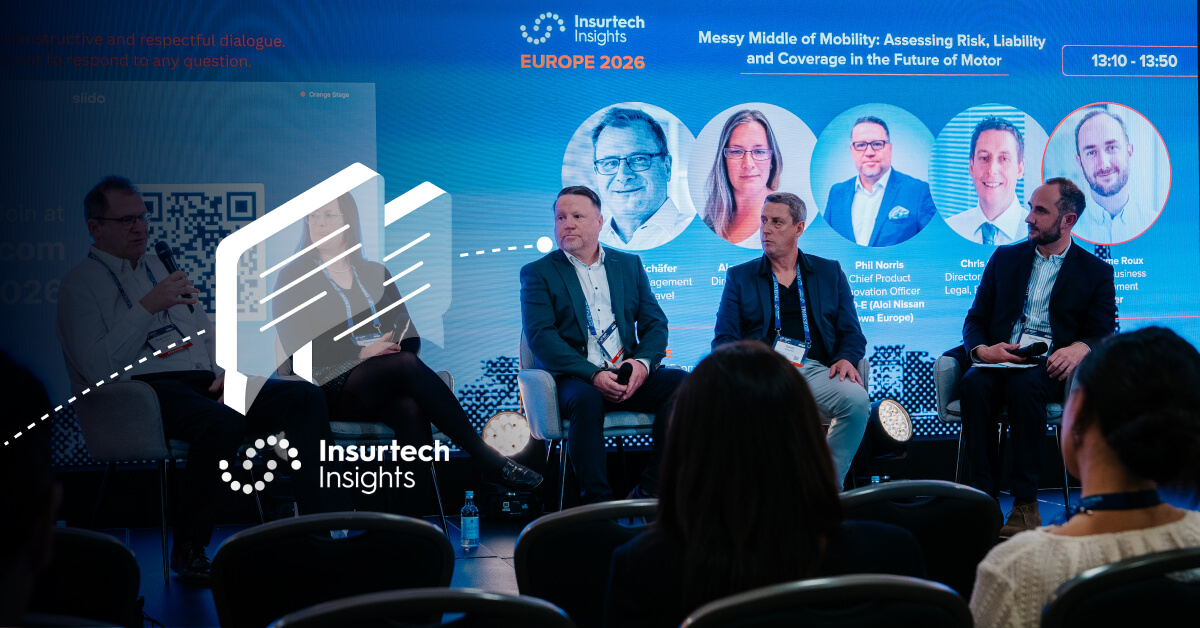
At Insurtech Insights 2026 in London, I moderated a panel that tackled these challenges head-on: 'Messy Middle of Mobility: Assessing Risk, Liability and Coverage in the Future of Motor'.
Joining me were Chris Graville, Director of Insurance Legal, EMEA & APAC at Uber; Phil Norris, Chief Product Innovation Officer at AND-E (Aioi Nissan Dowa Europe); Alexandra Wyard, Director of Technical Underwriting for Allianz Personal Lines UK; and Ralf-Peter Schäfer, VP Product Management for Traffic and Travel Information at TomTom.
Together, we explored why this transition period is so complex, how data is reshaping the insurance value chain and what insurers need to do now to prepare for a very different future.
Autonomous vehicle insurance in transition: why the middle is messy
I opened the panel with a simple question: what exactly is the messy middle of mobility, and why is it messy?
The answers revealed just how profound this transformation really is.
'If you remove the at-fault driver which has been around for decades and decades, then clearly we get into some very tricky legal questions and practical questions as we transition.' – Chris Graville, Director of Insurance Legal, EMEA & APAC at Uber
Chris put it well – when you remove the human driver from the equation, you remove the foundation that motor insurance has been built on for over a century. Liability shifts from individuals to manufacturers, software providers and fleet operators. And figuring out who's responsible when something goes wrong becomes exponentially more complex.
‘Middle indicates a single point. It's an expanse of time where everyone will be right for a period until we've all agreed actually what is right. And that's where there's this conflict.' – Phil Norris, Chief Product Innovation Officer at AND-E
Phil's point captures the essence of the challenge: we're not at a crossroads, we're in a long transition where multiple models will coexist, creating friction between technology capabilities, consumer expectations, regulatory frameworks and automotive insurance solutions.
Alex from Allianz emphasised that this evolution doesn't have a clear endpoint.
'This is about an evolution to an unknown end point and actually arguably will never end in terms of the way that we choose to live our lives, the way that society will evolve and actually the way that we choose to move around and interact with each other. So it's messy because it's unknown.' – Alexandra Wyard, Director of Technical Underwriting for Allianz Personal Lines UK
Ralf brought a technology perspective to the challenge.
‘We are in the beginning of a technology revolution. The discipline of automation and mobility is very young compared to the history of driving as a human being. We have to translate the perception, model, action and ownership of a driver into a technology stack which is very complex and all the corner cases we have to train in our models, which is a challenge on its own.' – Ralf-Peter Schäfer, Product Head at TomTom
Redefining motor insurance products for autonomous vehicles
One of the most interesting parts of our discussion was unpacking what motor insurance even means in an autonomous world.
As Alex explained, it's not simply about replacing one product with another – it's about reimagining coverage entirely.
'When we talk about insurance for AVs, what are we talking about? Is it motor insurance, liability, product liability, cyber insurance? It's everything really in lots of ways.' – Alexandra Wyard, Allianz Personal Lines UK
Right now, insurers are adapting existing personal lines and commercial products to cover vehicles with assisted driving features. But as technology advances and legislation catches up, we'll need entirely new product structures.
The challenge becomes even more complex when you consider the different use cases. A fully autonomous shuttle operating in a controlled environment at an airport is a completely different risk than a Level 3 autonomous vehicle navigating London traffic during school run hours – even if the underlying technology is similar.
As these diverse use cases emerge, omnichannel insurance distribution becomes essential to serve different customer segments with tailored experiences.
Chris highlighted how the industry is already moving toward consolidated coverage models to address this complexity.
'You combine all sorts of new and emerging risks with a number of players in deployment of autonomous vehicles. You've got the owner, the fleet operator, could be the same, might not be the same. You've then got the manufacturer and you've got the software provider. Trying to figure out between each of those parties where risk should go and how claims are handled is very tricky.' – Chris Graville, Uber
The solution is to wrap policies that cover all parties under a single program, eliminating gaps in coverage and providing absolute clarity. Uber recently launched this type of policy, and Chris believes it's where the market is heading across the board.
The shift to autonomous vehicles mirrors challenges already facing the EV market.
See how auto companies are adapting to electrification →
.jpg)
Data as the new foundation in motor insurance
One of the most fascinating parts of our discussion was unpacking what motor insurance even means in an autonomous world.
If there's one thing everyone agreed on, it's this: data will be the foundation of motor insurance in the autonomous era.
Phil made a compelling point about how telematics has already started this shift.
'Telematics moved the thinking away from historic averages to actual live data. So this is happening across the piece. Connected data becomes more and more important. Cars are crashing less and they will continue to do so. They will talk to each other. So the role of the human gets smaller and smaller anyway.' – Phil Norris, AND-E
Ralf from TomTom explained how mapping and location data can extend the perception horizon of autonomous vehicles, providing information beyond what sensors can see.
'There's a huge opportunity. We can give a lot of extra content and data which expand the horizon of the car. There's mapping – not only a map to navigate from A to B but an ADAS high definition map with all the attributes: lane level, pavement condition, density, curvature, speed restriction. All that's relevant to have a mid- and long-term horizon.' – Ralf-Peter Schäfer, TomTom
This data doesn't just help vehicles drive more safely – it helps insurers understand risk in fundamentally new ways. Real-time hazard information, weather data, traffic patterns and vehicle-to-vehicle communication all contribute to more accurate risk assessment.
But as Chris pointed out, this also shifts the power dynamic in the insurance ecosystem.
'Traditionally it'll be the insurance company that has the black box of data. And that means they can underwrite, they can price, they can adjust cover as they need. Given this change, the data will probably be with the fleet partners or the owners. It'll be within the ecosystem as opposed to with insurers.' – Chris Graville, Uber
This creates both a challenge and an opportunity for insurers. Some platforms will be tempted to self-insure – and we're already seeing this with Tesla, Amazon and Waymo.
But insurers still bring critical value: underwriting expertise, claims infrastructure, risk capital and decades of experience managing complex problems at scale.
How insurers should adapt for autonomous vehicle coverage
Alex made an important point about the insurance industry's capacity for evolution, but also highlighted the cultural changes needed to capitalise on this transition period.
'I genuinely believe that the insurance industry is very capable of evolution and change. If you look across our history and the kind of risks that are being written, I think there are a couple of shifts that are needed. The clarity of the use of data, there needs to be that ecosystem, there needs to be a true understanding of where the data's stored, how it's accessed and how it's used.' – Alexandra Wyard, Allianz Personal Lines UK
She emphasised the importance of innovation, collaboration and not being afraid – especially when the inevitable first major autonomous vehicle incident occurs.
'We as an industry need to be thought leaders. We need to be prepared to stand up and say, are we comfortable with this technology and are we prepared to back it? Because that's the thing that will allow these vehicles to go mainstream.' – Alexandra Wyard, Allianz Personal Lines UK
Phil took it further, arguing that the shift goes beyond product innovation – it's about fundamental business model transformation.
'With the move towards autonomous vehicles, what happens to motor third party liability? Part of that starts to be taken by the manufacturer, so it definitely shrinks, it becomes part of the warranty and the insurer then sits in a different place – behind the OEM rather than the customer.' – Phil Norris, AND-E
Motor insurance partnerships are evolving to reflect this shift, with insurers playing a more collaborative role.
In a world where vehicles are used as a service rather than owned, where fleets self-insure comprehensive coverage and where liability increasingly sits with manufacturers, insurers need to rethink their entire value proposition.
Learn more about how the shifting automotive ecosystem is driving innovative insurance models →
.jpg)
Regulatory frameworks for autonomous vehicle liability
Chris highlighted just how critical regulatory clarity is to making this transition work.
'The regulator's role is really important, aside from just making sure safety's top of mind and licensing rules are in place. There's probably two things. One's allocation of liability and I think data is the other thing. Just making sure there are rules around what data should be disclosed and when, particularly at the claim stage.' – Chris Graville, Uber
He pointed to the UK as one of the most progressive markets in this regard.
'What's really interesting in UK regulation is it actually says once that autonomous function is engaged, it’s a software provider that is primarily liable. That's really helpful because what that means is for a claimant or the court, you go to one person and then they have to figure out the rest after that.' – Chris Graville, Uber
This type of regulatory clarity removes ambiguity for consumers, enables insurers to design appropriate products and gives manufacturers confidence to deploy autonomous technology.
But Phil highlighted an often overlooked dynamic: regulators aren't working in isolation, they're actively seeking input from the industry.
'The regulators do need our help. A regulator from the Far East came and spent some time with us, trying to understand our experience so they could write their rules, really understanding what do insurers want? And we do have an education role. What's acceptable and what's not takes time and it takes information.' – Phil Norris, AND-E
Insurers have a unique vantage point – we see claims data, understand risk patterns and can help shape practical frameworks that balance innovation with consumer protection. We're not just recipients of regulation, we're collaborators in building it.
Ralf added another crucial dimension: regulation needs to be context-aware, not one-size-fits-all.
'Regulation is also about what we allow as a minimum standard. In a city, it's a different ecosystem for fully autonomous driving than on a motorway. We can create consensus on what is really the minimum standard to allow as a mass phenomenon for autonomous driving. Don't go for the most you can do as a corner case – it's about what, from a mass market perspective, you can regulate with a good consensus of safety.' – Ralf-Peter Schäfer, TomTom
A vehicle navigating urban zones needs different guardrails than one on a motorway. Smart regulation will be data-informed, context-specific and focused on establishing baseline safety standards that enable deployment at scale – not just experimental edge cases.
.jpg)
The future standard for connected and autonomous vehicle insurance
I asked each panellist to look ahead and predict what will define motor insurance in the next three to 10 years.
Ralf emphasised the importance of adaptive AI models that can learn from real-world data and corner cases.
'Those models will win when they can utilise the massive amount of data now arriving from the car in the cloud. Your agentic AI should be adaptive like a human being. You learn in the loop, and improve day by day and those models will win.' – Ralf-Peter Schäfer, TomTom
Alex took a more pragmatic view, arguing that the next decade is about preparation rather than widespread deployment.
'I think the next three to 10 years is a little bit too soon to be thinking about fully autonomous vehicles being mainstream in the consumer market. The key to successful insurance provision is getting set for when it is there. We've got to really make the most of our data and experience on everything we have now, understand which manufacturers are doing things really well, create thought leadership within our businesses and get set with partnerships and products.' – Alexandra Wyard, Allianz Personal Lines UK
Phil echoed this sentiment, emphasising that today's success funds tomorrow's innovation.
'Who's successful in the next three to 10 years? The people who do today's business well. Those that aren't doing well won't have any money or time to think about the future. And those that do well should put that time and money aside because now is the time to train to be ready. Because that pivot point was difficult to predict when it would be.' – Phil Norris, AND-E
Chris summed it up simply but powerfully.
'From an auto insurance perspective it will gradually transition to other kinds of risks and it'll be things like cyber and product liability. There'll just be a gradual transition, and the policies will adapt to that.' – Chris Graville, Uber
Navigating the messy middle together
If there's one takeaway from this panel, it's that no single player can navigate this transition alone.
Insurers bring risk expertise and claims infrastructure. Manufacturers bring vehicle data and customer relationships. Mobility platforms bring usage insights and scale. Insurance orchestration platforms bridge the gap, connecting traditional insurance capacity with modern distribution channels through embedded technology. And regulators bring the clarity needed to make it all work.
The messy middle isn't just about autonomous vehicles – it's about reimagining the entire mobility ecosystem and the role insurance plays within it.
The good news is the insurance industry has navigated fundamental shifts before. We've evolved products to meet changing customer needs for over a century. This transition will be no different – as long as we're willing to collaborate, innovate and embrace the uncertainty that comes with building something entirely new.
Want to explore how Qover helps mobility platforms and car manufacturers design insurance programs for the future? Get in touch with our team.
.jpg)

.webp)