
What frictionless insurance really looks like in 2026
In a nutshell
- Frictionless insurance isn't just about technology – it's about context, timing and relevance. Insurance should appear at the right moment in the customer journey, without interrupting it.
- Successful programs require localisation, omnichannel thinking and a tech layer that absorbs the real complexity of scaling across Europe, because there's no universal customer journey.
- The strongest embedded insurance partnerships are built on shared intent and open architecture. Flexibility from day one is what allows them to evolve and last.


Alex is in charge of content marketing at Qover, meaning she's obsessed with all things storytelling and tone of voice.
With more than a decade of experience in content strategy, copywriting, editing and SEO, she's worked for media companies, marketing agencies and startups across the globe.
When she's not writing or strategising, you'll likely find her in a language class (Dutch, currently), on a spin bike or diving into her latest Netflix binge.
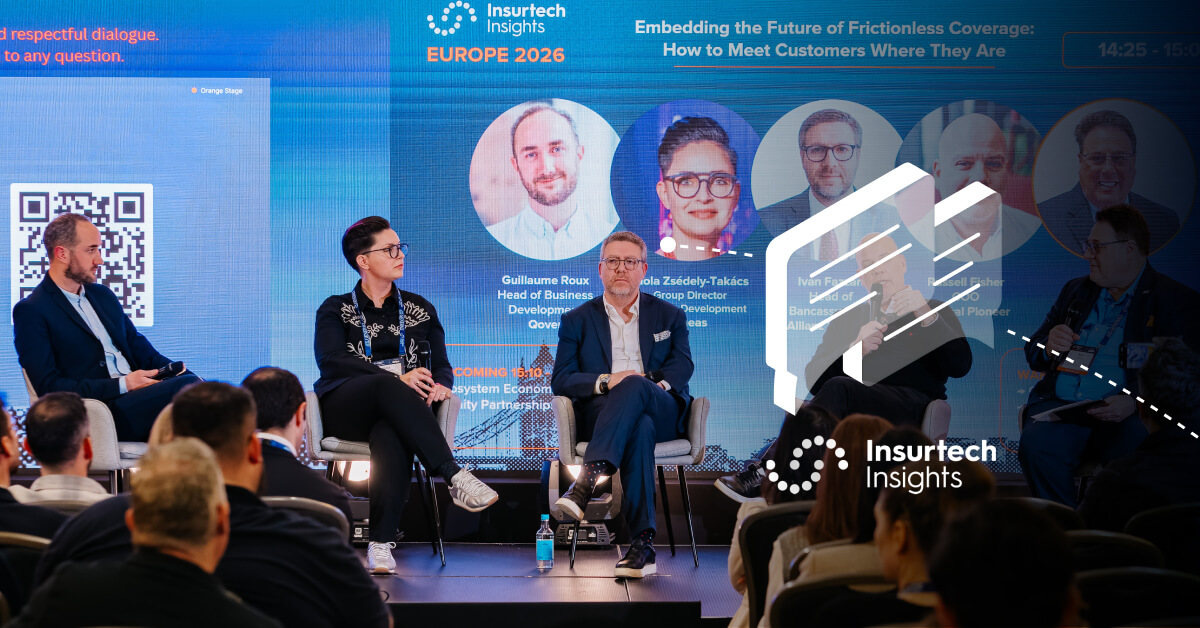
At Insurtech Insights 2026, five practitioners sitting across the full insurance stack – from global insurer to insurtech orchestrator – got on stage to work it out.
The panel 'Embedding the future of frictionless coverage: how to meet customers where they are' brought together Russell Fisher from Admiral Pioneer, Ivan Fazzari from Allianz Partners, Viola Zsédely-Takács from Ageas, and Guillaume Roux, Head of Business Development at Qover, with Ken Leibow of InsurTech Express moderating.
They talked about what frictionless insurance actually means, how to build programs that work across markets and what separates the partnerships that scale from the ones that don't.
What frictionless insurance actually means in practice
So what does frictionless actually mean in practice?
For Russell, it starts with context: insurance should appear at a moment that makes sense to the customer without interrupting what they came to do.
'You should never leave that primary journey. It's very easy to say it's all about tech – it's not. It's about the journey and the customer experience you want to deliver. Tech is the enabling capability.’ – Russell Fisher, Admiral Pioneer
Ivan pushed the thinking further, framing insurance as a benefit that should be further embedded in a customer’s life when something goes wrong.
'We’re really moving from insurance as a product to insurance as a benefit. It's a massive shift – because of course, it takes technology in order to be enabled. It takes what I would call a parametric trigger in order to be effective.' – Ivan Fazzari, Allianz Partners
Viola added price and personalisation to the equation.
‘Frictionless also includes the right product for the right audience, priced at the right level. As a customer, I often get totally irrelevant suggestions. Based on that, I know this platform doesn’t really know who I am or what my preferences are. And for me that really breaks the whole of the experience.’
Of course it wouldn’t be an insurtech panel in 2026 without addressing the linguistic debate between ‘frictionless’ and ‘embedded’ insurance. Guillaume had a characteristically direct take.
'I like “frictionless” coverage even better than “embedded” insurance. There’s an endless debate around what’s embedded and what’s not. Some people consider it when insurance is embedded by default into a credit card or banking plan. For others, embedded insurance can also be transactional programs where the customer journey is extremely well integrated. I believe it covers both. So I like frictionless coverage because it's killing that useless debate.'' – Guillaume Roux, Head of Business Development, Qover
.jpg)
How to find the right moment in the customer journey
If frictionless coverage means including insurance at the right time, the real question becomes: when exactly should it appear?
Ivan outlined three broad moments, depending on the product and context: the point of purchase (e.g. booking a flight or activating a mobility service), the days that follow when customers begin asking 'what if I need this?', and major life events like buying a home or starting a family.
Viola added that irrelevance is itself a form of friction. Getting a generic insurance pop-up that has nothing to do with who you are doesn't just fail to convert; it actively damages the experience and the brand behind it.
Russell was blunt about what that means for anyone building these programs: know your place.
'People aren't going there to buy insurance. They're going there to access a vehicle or to do their banking. We need to know our place. We are a secondary product, an enabler to the job the customer wants to do – and therefore we should get out of the way and let them do the job they want to do.' – Russell Fisher, Admiral Pioneer
That said, if insurance is supposed to disappear into the background, why are some of the most recognisable brands investing in making it a central part of their offering?'
There's no universal customer experience for frictionless insurance
For Guillaume, the more pressing question isn't why – it's how brands are making embedded insurance a central part of their offering. And the starting point is admitting there's no single right way to do it.
Every car manufacturer, mobility platform and bank brings a unique brand, customer base and way of going to market.
As Guillaume puts it: 'For global players like Tesla or Revolut, Europe is a region for them. They expect one partner to manage their entire region – one single insurance program, similar products across Europe, a similar customer experience, one team to manage claims.'
The reality, he explained, is far messier. Insurance is a multi-local business by default.
Even the biggest insurance brands – Allianz, Generali, Zurich – operate through local entities with different products, different insurance regulations and different customer journeys in each market. That gap is precisely where technology becomes essential.
Despite not having a perfect template for a frictionless insurance experience, Guillaume laid out a set of guiding principles that consistently drive program success:
- Localise: a customer in the UK doesn’t buy insurance the same way as a customer in France or Germany – and your program needs to reflect that. Tech can help tackle local insurance challenges.
- Go omnichannel: dealerships and bank branches still drive significant insurance volume; don't neglect them in favour of digital-only thinking.
- Remove repetition: customers should never enter the same data twice.
- Build multiple touchpoints: expecting 100% of customers to convert at a single checkout moment is unrealistic.
- Commit to continuous improvement: going live is the start, not the finish. ‘You have months, sometimes years of looking at performance, adding functionality, fine-tuning. That's how you find the best conversion rate’, Guillaume said.
Explore how omnichannel insurance for car manufacturers drives volume →
.jpg)
What makes or breaks an embedded insurance partnership
Once brands understand that they need the right partner to make their embedded insurance program work, how can they ensure it’s a match from day one?
Ivan introduced the marriage analogy. For him, a bad partnership is one where all the energy goes into the wedding and not enough into the day-to-day partnership. The daily back-and-forth is what it really takes to build trust and make a partnership work. That, and of course, plenty of patience.
Russell was clear about what kind of relationship makes it work: these are true partnerships, not supplier-distributor arrangements, with skin in the game on both sides. And his test for whether a partner is right comes down to what their intent is.
'If a partner comes to us and says they're just really interested in generating some revenue from insurance, I'm probably not that interested in partnering with them. We're really interested in how we can serve our customers better. We know if we do that well, the revenues will follow. But you've got to start with the intent that what you're trying to do is make your customers' lives better and deliver value to them.' – Russell Fisher, Admiral Pioneer
Viola stressed the importance of aligning on shared goals, clear responsibilities and commercial targets from the very beginning. She also emphasised that delivery requires the right people, not just the right technology.
'It really takes a village. Because often, especially the embedded projects, they cut across partner, enabler, insurer – but also different departments that normally don't even speak to each other: legal, DPO, tech, product, pricing, underwriting, marketing, customers. Everybody needs to come together and everybody's equally important in delivery.' – Viola Zsédely-Takács, Ageas
.jpg)
Guillaume extended the marriage analogy to reflect Qover's own approach to orchestration – and why building for flexibility matters as much as building for launch:
'A good marriage is also when you consider that you could potentially break up. The reality is, you have two or three different companies with their own roadmaps and strategies. Maybe two or three years in, one of the companies has a different strategy, and too often people are stuck in a partnership where they’re unhappy and it's not working.
One of the benefits of isolating every part of the value chain is that if somebody in the ecosystem no longer wants to take part, you can easily withdraw and let somebody else take that part. So you can change insurers or add a new insurer very easily, and keep what’s been built over the years without removing the full partnership.' – Guillaume Roux
This modular, open architecture is also what makes scaling embedded insurance across multiple markets achievable.
What embedded insurance partnerships look in 2026: from linear deals to ecosystem orchestration →
The road ahead for frictionless insurance
As the panel came to a close, the outlook on frictionless insurance was clear if ambitious.
Russell reiterated that it’s all about context. Customer expectations are set by companies like Amazon now – insurance needs to meet that bar or get left behind.
Ivan emphasised that insurance can’t grow without technology and agentic AI helping with customer interactions and managing data. It will be the right balance between localisation and scalability.
Viola pointed out that embedded insurance represents a low single-digit share of overall distribution today, but she's hoping for double digits within five years. ‘That means we’ve found scale, that customers are implementing, accepting, buying and ultimately giving the feedback that it's working.’
Guillaume was short and succinct as time ran out: 'It's all about data being pre-filled and offering the right product to the right customer at the right time.'
The companies that build with that in mind – not just a tick box at checkout, but a contextual, localised, continuously improving program – are the ones that will get frictionless insurance right.
Want to see how Qover helps brands build frictionless, multi-market insurance programs? Get in touch with our team.


.jpg)