
AI governance in insurance: moving too slowly or taking the time to get it right?
In a nutshell
- AI isn't one technology with one level of risk. An agent explaining how to submit a claim needs very different controls from a system deciding whether to reject it.
- Insurers have good reasons to be cautious. But delay has a cost too, and staying with the current process should be a decision backed by evidence, not a default.
- Risk carriers and their partners can do this better together, with shared evidence, oversight that matches the risk, clear timelines and data that keeps coming in after launch.


Quentin Colmant is the CEO of Qover, which he co-founded alongside Jean-Charles Velge in 2016. Prior to launching the company, he had a successful career in the insurance industry, holding a series of top management positions at Allianz Benelux in both general and life insurance.
Quentin has an MBA and two Master's degrees: a Master's in Engineering Science & Applied Mathematics and a Master's in Finance.
Insurance has become very good at announcing AI. Getting it approved for the people who serve customers every day can be a different experience.
At Qover, we see both sides. We're deploying AI in customer care and working with our risk carrier partners to agree where it can operate. Some uses move forward quickly. Others stay stuck behind restrictions, extra reviews or written approval before any customer can benefit.
I think that gap is worth closing. But describing it as insurers saying one thing and doing another would be too easy. It would also be unfair to the people responsible for protecting policyholders. There are good reasons to be careful. There are also ways of being careful that leave everyone waiting. For me, that's what AI governance in insurance should be about: learning to tell the two apart.
Curious what we've learned so far? Read about our experience with AI claims processing →
What AI in customer care actually looks like at Qover
When I wrote about AI in insurance back in 2024, I argued that customer care and claims were the obvious place to start. Two years on, much of the debate still treats AI as one technology with one level of risk, which makes a useful conversation difficult.
An agent explaining how to submit a claim is doing something very different from a system deciding whether to reject it. Giving AI permission to answer a question shouldn't automatically give it permission to change a policy or move money.
At Qover, our customer care AI retrieves information from an approved knowledge base to answer simple questions by email, chat and phone. Separate tools help identify what the customer is asking for, check documents and suggest next steps to claims handlers. Each one has a defined purpose and clear limits. We haven't handed an unrestricted language model a pile of old conversations and asked it to run customer service.
The less glamorous work matters much more: preparing accurate insurance information, defining when the system must stop, testing it with different questions and reviewing what happens in practice.
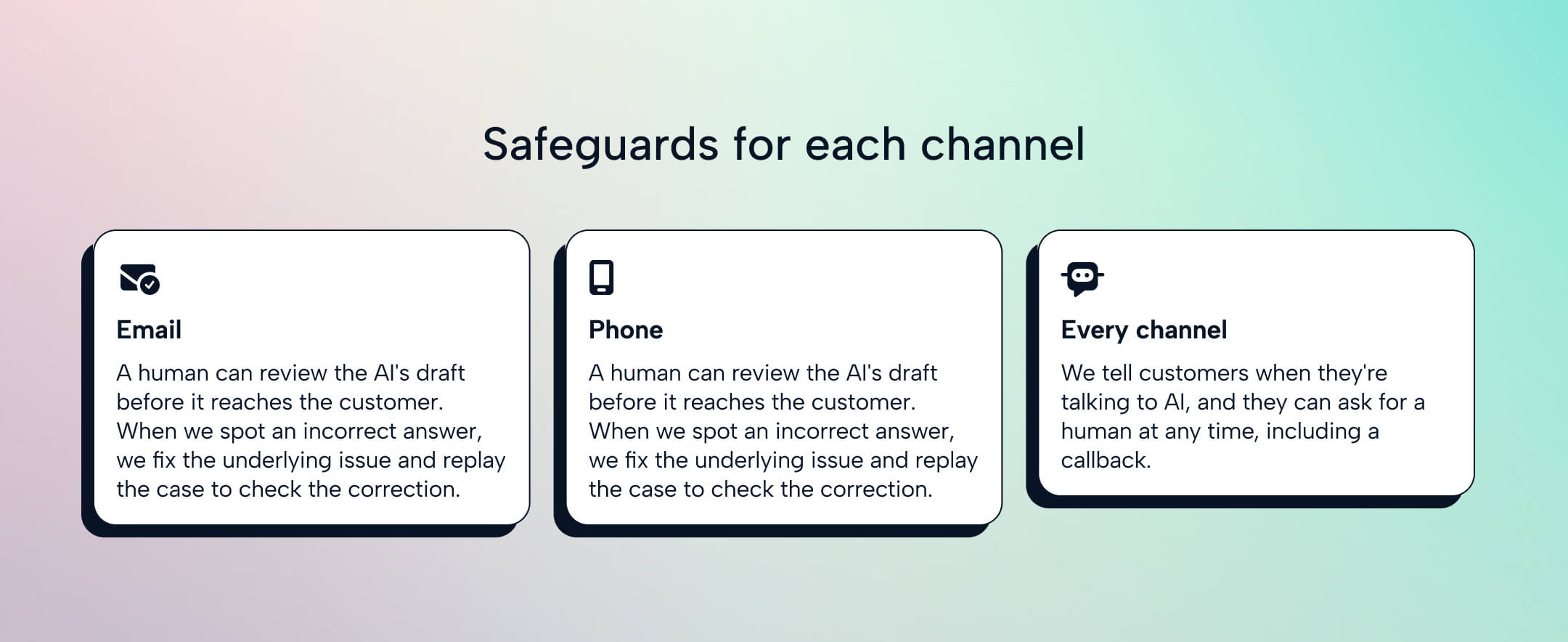
Complaints, vulnerable customers and questions outside the approved scope need particular attention. A confident-sounding answer is no substitute for knowing when to hand over.
The gains can be substantial without any hype. An early internal review in December 2024 looked at email questions answered within the same business day. That share went from around 25% to around 60% after we introduced AI, with accuracy reported as comparable to human agents. It was an early result, not a benchmark for every insurance program. But for someone waiting to understand their cover, a faster, correct answer makes all the difference.
Why insurers hesitate – and why they sometimes should
Now put yourself in the risk carrier's position. A partner wants to introduce an AI tool that talks to your policyholders. That tool relies on another supplier, which may rely on a model provider and other tech partners. You need to know where the data goes, what the system can say and who's responsible when it gets something wrong.
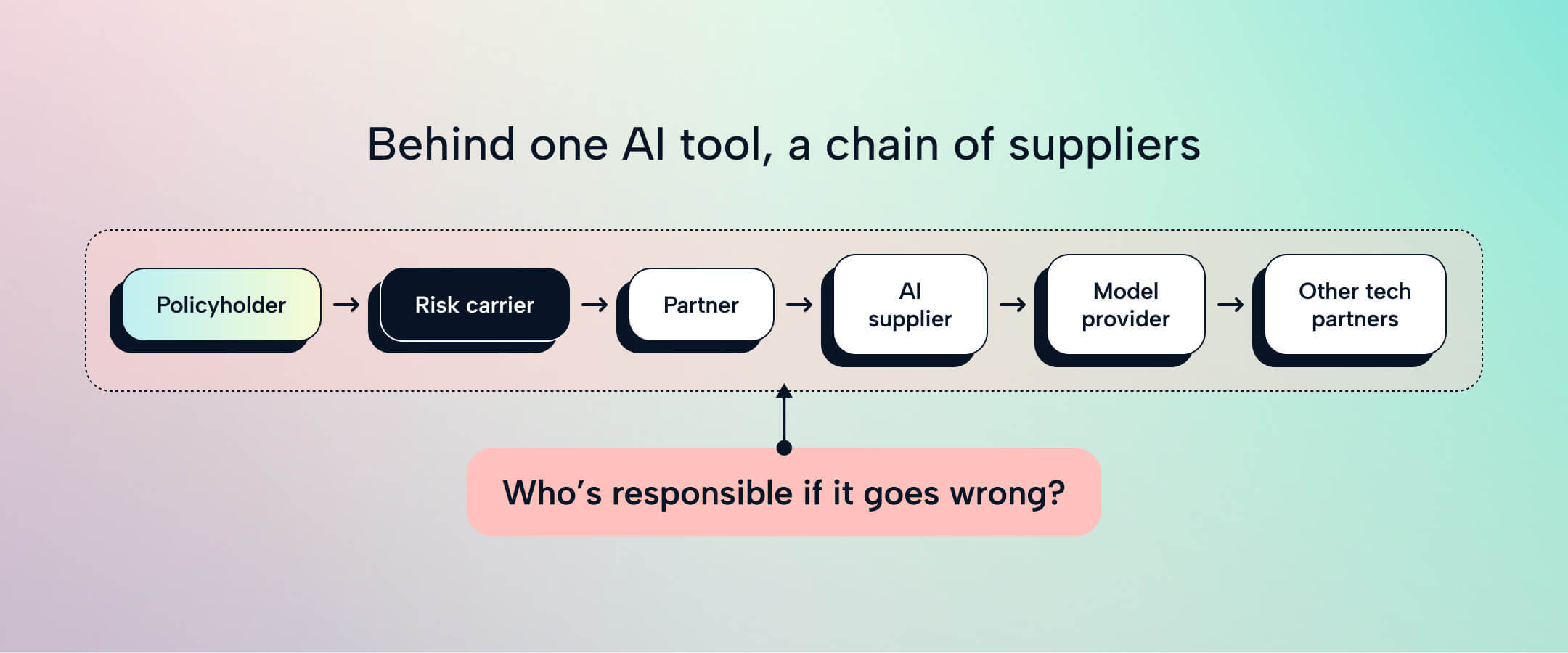
A mistake about insurance can affect someone's financial decisions. Automation can also repeat that mistake across many conversations before anyone notices. Asking for evidence is entirely reasonable.
Our agreements reflect those concerns. They include:
- descriptions of the systems we use
- limits on using partner data to train models
- records of how we use AI
- human oversight
- the right to withdraw approval if customers are being harmed
We should be honest about our own experience too. We've paused automated replies and gone back to human review when response quality needed attention, including after a carrier raised concerns. It's a useful reminder that oversight can catch genuine problems.
I wouldn't trust a partner who claimed their AI never made mistakes. I'd want to see how quickly they spot a problem, how they help affected customers and whether they can safely switch the automation off.
The wider industry is still learning as well. A February 2026 survey by the European Insurance and Occupational Pensions Authority (EIOPA) found that nearly two-thirds of responding insurers were actively using generative AI, but most were still at proof-of-concept stage. Data privacy and security concerns, regulatory compliance and a lack of skilled staff were the main hurdles.
An insurer can believe in AI and still be cautious about a specific use. An internal assistant helping an employee draft a document isn't the same as a partner's agent speaking directly to customers.
What regulation expects from AI governance in insurance
The EU AI Act doesn't classify every use of AI in insurance as high-risk. Its insurance-specific high-risk category covers AI used for risk assessment and pricing in life and health insurance. Other uses still fall under data protection, consumer protection and insurance rules.
For automated claims decisions, the General Data Protection Regulation (GDPR) deserves particular attention. Article 22 restricts decisions that have legal or similarly significant effects when they're based solely on automated processing, with specific exceptions and safeguards. So an automatic claim rejection needs a different review from an answer explaining which documents to send. Calling both of these 'AI' tells us very little about how to govern them.
EIOPA's Opinion on AI governance and risk management supports a proportionate, risk-based approach. It pays attention to data governance, explainability, security and human oversight. That's a far more useful starting point than assuming every tool needs the same approval process.
Equally, 'not high-risk under the AI Act' doesn't mean 'nothing to worry about'. We still have to prove that a service works safely for the people using it.
Want to go deeper? Watch our webinar on AI in insurance claims and customer care →
'Not yet' has a cost too
My concern starts when a reasonable review becomes one with no end date.
A narrowly defined use of AI can spend months moving through one review after another. Each team may be asking sensible questions. But without agreed criteria and a clear timeline, it's hard to know what's still needed to reach a decision. Everyone supports the idea in principle while the customer keeps waiting.
From the customer's side, an unavailable tool and a tool awaiting approval look exactly the same. Neither one answers their question.
We're right to examine the risks of introducing AI. We should look at the cost of delay just as carefully: longer queues, more repeat contacts and less time for human agents to help people in difficult situations.
That doesn't justify cutting corners. It does mean that sticking with the current process should be an explicit decision backed by evidence, not a default nobody questions. We should compare AI with the service customers actually get today. That means looking at accuracy, how serious the errors are, accessibility and how easy it is to reach a person. Speed alone isn't enough, but it shouldn't be dismissed either.
Customer care will become a different job
There's a people question inside all this too. I expect experienced customer care professionals to spend more of their time supervising AI agents, improving what those agents know and handling situations that need judgement or empathy.
That will take serious investment in people. Someone who's spent years understanding customers and insurance wording brings valuable expertise to an AI system. We should give them the tools, authority and training to use it.
The economics of repetitive work will change too. I'm sceptical of business models whose main advantage is moving routine tasks somewhere cheaper. But declaring outsourcing dead ignores the expertise good service partners bring.
The lasting advantage will come from knowing the insurance product, keeping information reliable and being able to show that customers get good service. Buying access to a language model won't be enough.

How we can make AI approval work better, together
I'd like risk carriers and their delegated partners to agree on a more practical way forward. Here's where I think we could start.

A shared evidence pack: a clear description of each use case, its data flows, test results, how it escalates to a human and how incidents are handled. Carriers will still have different needs, but we shouldn't have to explain the same foundations from scratch every time.
Oversight that matches the activity: answering a general question, changing a policy and making a claims decision deserve different controls. Permissions should be specific enough to protect customers and clear enough for an operations team to follow.
An owner, a timeline and a route for changes: routine updates within agreed limits could follow a documented testing and notification process. Changes to decision-making authority, sensitive data use or suppliers may need a fresh review. Nobody should have to guess which applies.
Evidence that keeps coming in after launch: carriers should see errors, complaints, human interventions and service performance, including where AI is making things worse. A clear ability to pause or reverse a deployment should be part of the agreement.
At Qover, we have a responsibility here too. We need to make our systems easier to understand and our evidence easier to challenge. We can't ask partners to accept a presentation as proof.
I believe our carrier partners also have an opportunity to help define what good looks like. Their experience of risk, regulation and customer protection is essential to making this work.
My invitation is simple: let's pick a well-defined use case, agree on safeguards and measure the service together. We can expand where the evidence supports it and change course where it doesn't.
I'd like our next AI announcement to be a joint one: fewer customers waiting, better answers and a service we can all stand behind.